Choosing an SMD Screen for your business involves more than finding a display that fits an available wall. The right screen should make your content easy to see, suit the viewing distance, fit the installation space, and deliver the visual impact you expect. A screen that is too small may struggle to attract attention. One that is unnecessarily large can increase your investment without improving the viewing experience. Whether you’re planning a digital advertising screen for a shopping mall, an outdoor LED billboard, a corporate presentation display, or an indoor screen for your showroom, understanding how screen sizes are calculated can help you make a better decision.
At MNK Digital, we help businesses across Pakistan select SMD display solutions based on their installation requirements, viewing conditions, and intended use. This guide explains the calculations and practical considerations you should understand before investing in an LED screen.
Why Does SMD Screen Size Matter?
An SMD (Surface-Mounted Device) LED screen uses numerous LEDs arranged across display modules to create images, videos, and other digital content. Unlike a conventional television, an SMD screen can be assembled from multiple modules and cabinets to achieve different display dimensions.
This flexibility makes SMD technology suitable for a wide range of business environments, including:
- Retail stores and shopping malls
- Corporate offices and conference rooms
- Restaurants and entertainment venues
- Exhibition halls and event spaces
- Outdoor advertising locations
- Educational institutions and auditoriums
However, every location has different requirements. For example, an LED screen installed behind a retail counter may be viewed from only a few feet away. An outdoor billboard, on the other hand, might be viewed from across a road. Both locations require different approaches to screen size, pixel pitch, brightness, and installation planning. The objective is not simply to install the biggest screen possible. It is to choose a display that communicates your message clearly.
Step 1: Measure Your Available Installation Space
Before choosing an SMD screen, measure the wall or structure where you intend to install it.
You need two measurements:
- Width: The horizontal space available for installation.
- Height: The vertical space available for installation.
For example, suppose your business has a wall measuring:
- Wall width: 20 feet
- Wall height: 10 feet
This gives you a total wall area of:
Wall Area = Width × Height
20 × 10 = 200 square feet
However, this doesn’t necessarily mean you should install a 200-square-foot SMD screen. You may need additional space for mounting structures, maintenance access, electrical connections, ventilation, or other site-specific requirements. It’s also important to remember that LED screens are assembled using modules and cabinets with fixed physical dimensions. The final display size must therefore be compatible with the available module and cabinet dimensions.
Convert Feet into Metres
Most LED manufacturers provide module and cabinet dimensions in millimetres, so converting your measurements into metric units makes planning easier.
1 foot = 0.3048 metres
For a wall measuring 20 × 10 feet:
- Width: 20 × 0.3048 = 6.096 metres
- Height: 10 × 0.3048 = 3.048 metres
Your available wall space is approximately 6.10 × 3.05 metres. These measurements provide the starting point for selecting a suitable LED screen configuration.
Step 2: Calculate the SMD Screen Size Using LED Modules and Cabinets
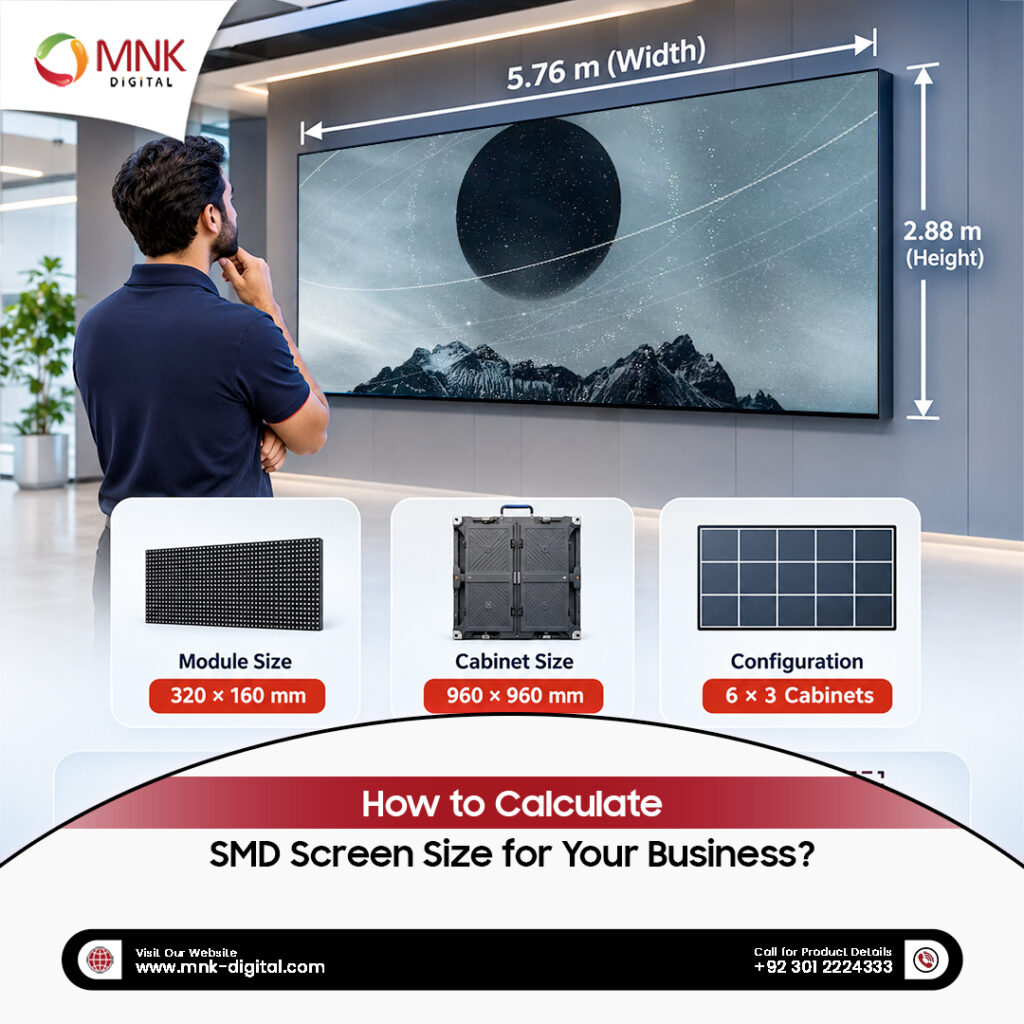
SMD screens are assembled using smaller LED modules that fit together inside larger cabinets. Understanding both module and cabinet dimensions helps you calculate the actual display size and the number of components required for installation. For this example, we’ll use an LED module measuring 320 × 160 mm (Width × Height) and a cabinet measuring 960 × 960 mm. These are example specifications. Actual module and cabinet dimensions depend on the selected LED display model.
What Is the Standard SMD LED Module Size?
One commonly used SMD LED module size is 320 × 160 mm, equivalent to approximately 1.05 × 0.52 feet. An LED module is a smaller display unit containing LEDs arranged in a grid. Multiple modules are combined to create a larger display cabinet, and several cabinets are connected to form a complete SMD screen. Module dimensions can vary between manufacturers and product series, so it’s important to confirm the specifications before planning an installation.
How Many LED Modules Fit Inside One Cabinet?
Let’s assume your selected LED cabinet measures 960 × 960 mm and uses 320 × 160 mm modules.
Modules Horizontally = Cabinet Width ÷ Module Width
960 ÷ 320 = 3 modules
Modules Vertically = Cabinet Height ÷ Module Height
960 ÷ 160 = 6 modules
Total Modules per Cabinet = 3 × 6 = 18 modules
This means one 960 × 960 mm cabinet can accommodate 18 modules measuring 320 × 160 mm, provided the cabinet is designed for that module configuration.
Calculate the Number of LED Cabinets for Your Wall
Suppose your business has an available wall measuring 20 feet wide and 10 feet high.
First, convert the dimensions into metres:
- Wall width: 20 × 0.3048 = 6.096 metres
- Wall height: 10 × 0.3048 = 3.048 metres
Now calculate how many complete 960 × 960 mm cabinets can fit within the available dimensions.
Horizontal Cabinets = Wall Width ÷ Cabinet Width
6.096 ÷ 0.96 = 6.35
Round down to 6 complete cabinets.
Vertical Cabinets = Wall Height ÷ Cabinet Height
3.048 ÷ 0.96 = 3.175
Round down to 3 complete cabinets.
Total Cabinets = 6 × 3 = 18 cabinets
Calculate the Total Number of SMD LED Modules
We already calculated that each cabinet contains 18 LED modules.
Since the complete display uses 18 cabinets:
Total LED Modules = Number of Cabinets × Modules per Cabinet
18 × 18 = 324 LED modules
You can also verify this by calculating the number of modules across the complete display:
- Horizontal modules: 6 cabinets × 3 modules = 18 modules
- Vertical modules: 3 cabinets × 6 modules = 18 modules
Total Modules = 18 × 18 = 324 modules
Calculate the Final SMD Screen Dimensions
Now that we know the number of cabinets, calculating the actual display dimensions is straightforward.
Screen Width = Horizontal Cabinets × Cabinet Width
6 × 0.96 = 5.76 metres
Screen Height = Vertical Cabinets × Cabinet Height
3 × 0.96 = 2.88 metres
Total Screen Area = Width × Height
5.76 × 2.88 = 16.5888 square metres
Converting into square feet:
16.5888 × 10.7639 = 178.56 square feet
Complete SMD Screen Size Calculation Example
| Specification | Calculated Value |
|---|---|
| Available Wall Size | 20 × 10 feet |
| LED Module Size | 320 × 160 mm |
| LED Cabinet Size | 960 × 960 mm |
| Modules per Cabinet | 18 (3 × 6) |
| Horizontal Cabinets | 6 |
| Vertical Cabinets | 3 |
| Total Cabinets | 18 |
| Horizontal Modules | 18 |
| Vertical Modules | 18 |
| Total LED Modules | 324 |
| Final Display Width | 5.76 metres |
| Final Display Height | 2.88 metres |
| Total Screen Area | 16.59 m² / 178.56 sq. ft. |
Note: These calculations demonstrate a compatible module-and-cabinet arrangement. Actual products may use different dimensions. The calculation also assumes the full wall dimensions are available for the display; structural framing, mounting clearances, and maintenance access must be checked before installation.
Why Should You Calculate Both Modules and Cabinets?
Knowing the number of cabinets helps you plan the overall screen dimensions, supporting structure, and installation layout. Knowing the module count provides a clearer understanding of how the display is assembled and can also be useful when discussing replacement modules and maintenance requirements. For businesses comparing different LED screen configurations, these calculations make it easier to understand what is included in a supplier’s quotation.
Step 3: Understand Pixel Pitch and Viewing Distance
Screen size is only one part of choosing an SMD display. Pixel pitch is equally important. Pixel pitch refers to the distance between the centres of adjacent pixels, measured in millimetres.
Common LED pixel pitches include:
- P1.2
- P1.5
- P1.8
- P2.5
- P3
- P4
- P6
- P8
- P10
A smaller pixel pitch means pixels are positioned closer together, allowing more image detail within the same screen area. This is particularly useful when people will be standing close to the display. A larger pixel pitch may be suitable when the audience is viewing the screen from farther away.
Which Pixel Pitch Is Suitable for Your Business?
The following table provides broad starting points for planning. Actual viewing comfort depends on content, resolution, visual acuity, and installation conditions.
| Pixel Pitch | Approximate Starting Viewing Distance | Typical Application |
|---|---|---|
| P1.2–P1.8 | 1.2–1.8 metres | Meeting rooms, premium indoor displays |
| P2–P2.5 | 2–2.5 metres | Retail stores, showrooms |
| P3–P4 | 3–4 metres | Shopping malls, larger indoor displays |
| P5–P6 | 5–6 metres | Large indoor venues, some outdoor applications |
| P8–P10 | 8–10 metres | Outdoor advertising viewed from a distance |
These distances are approximate, not strict minimum requirements. For instance, if customers will stand around two metres from a display, a finer-pitch screen may be preferable to a P6 screen, especially if you’re showing detailed product images or small text.
Practical advice: Don’t choose pixel pitch based on price alone. Consider how close your audience will stand and what information they need to read.
Step 4: Calculate Your SMD Screen Resolution
Once you’ve determined the physical screen dimensions and pixel pitch, you can calculate the approximate pixel resolution.
The formula is:
Horizontal Resolution = Screen Width (mm) ÷ Pixel Pitch (mm)
Vertical Resolution = Screen Height (mm) ÷ Pixel Pitch (mm)
Let’s use our earlier example of a screen measuring 5.76 × 2.88 metres.
Convert the dimensions into millimetres:
- Width: 5,760 mm
- Height: 2,880 mm
Assuming a P2.5 display:
Horizontal Resolution:
5,760 ÷ 2.5 = 2,304 pixels
Vertical Resolution:
2,880 ÷ 2.5 = 1,152 pixels
The calculated resolution is:
2304 × 1152 pixels
This gives approximately 2.65 million pixels. For the example 320 × 160 mm module at P2.5, the calculated module resolution is 128 × 64 pixels. With 18 modules across and 18 modules vertically, the complete display would have 2304 × 1152 pixels. Actual product resolution must be confirmed against the manufacturer’s module specifications. Not every cabinet size is available with every pixel pitch, and physical pixel arrangements must use whole pixels.
Does a Bigger SMD Screen Always Mean Better Resolution?
Not necessarily. A larger screen using a coarse pixel pitch may have fewer pixels than a smaller screen using a fine pixel pitch. For example, two displays can have identical physical dimensions but very different resolutions if their pixel pitches are different. This is why screen size and pixel pitch should always be considered together.
Step 5: Choose the Right Aspect Ratio for Your Content
Aspect ratio describes the relationship between a screen’s width and height. One of the most widely used formats for business video content is 16:9.
This format is suitable for:
- Corporate presentations
- Product advertising videos
- Promotional content
- Conference and meeting displays
- Digital signage campaigns
For example, a screen measuring 16 feet wide and 9 feet high has a 16:9 aspect ratio. However, not every business needs a conventional widescreen display. A retail store may prefer a portrait-oriented screen for fashion advertisements. An exhibition organiser might need an extra-wide LED display across a stage. SMD technology allows different shapes and configurations, provided the selected cabinet system supports them. Before selecting your screen dimensions, consider the type of content you’ll display most frequently. If your existing videos are produced in 16:9, choosing a compatible screen ratio can help avoid unnecessary cropping, stretching, or empty space.
Step 6: Consider Indoor and Outdoor Installation Requirements
The correct screen size also depends on where the display will be installed.
Indoor SMD Screens
Indoor installations typically prioritise close-range viewing, image detail, comfortable brightness, and integration with the surrounding interior.
Common indoor locations include:
- Retail stores
- Corporate offices
- Showrooms
- Conference halls
- Shopping malls
Outdoor SMD Screens
Outdoor installations must account for sunlight, weather protection, structural safety, and longer viewing distances. The screen also needs appropriate brightness and environmental protection for the location. For example, a 10 × 6-foot screen may be sufficient for a retail showroom but could be difficult to read from a long distance on a busy road, depending on the content. When planning an outdoor display, assess the audience’s distance, viewing angle, traffic conditions, and the time people have to notice your message. A larger screen can improve visibility, but clear content and suitable pixel pitch are just as important.
Step 7: Calculate the Approximate SMD Screen Cost
After determining the screen size, you can begin estimating the project budget. SMD LED screens are often quoted based on their area in square metres or square feet, although pricing structures vary by supplier. A basic estimation formula is:
Screen Cost = Total Screen Area × Price per Square Metre
For example, if your calculated screen area is 16.59 square metres, multiply that area by the supplier’s quoted rate for the selected LED specification.
However, the display itself is not always the complete project cost. Your quotation may also need to account for:
- Supporting structure
- Controller and video processing equipment
- Installation and labour
- Electrical cabling and power requirements
- Additional site preparation
- Maintenance access and related requirements
Prices also vary according to pixel pitch, brand, indoor or outdoor specifications, brightness, and display technology. If you’re comparing quotations, make sure each supplier is quoting for equivalent technical specifications and installation requirements.
Common Mistakes Businesses Make When Choosing SMD Screen Sizes
Choosing a Screen Based Only on Wall Dimensions
The available wall size doesn’t automatically represent the correct display size. Module and cabinet compatibility, along with installation requirements, must be considered.
Ignoring Viewing Distance
A large display with unsuitable pixel pitch may not deliver the clarity your audience expects.
Selecting the Wrong Aspect Ratio
If your screen dimensions don’t match your advertising content, you may need to redesign or reformat the material.
Overlooking Installation and Maintenance Access
A screen that fits physically may still be difficult to install or service.
Comparing Only the Initial Purchase Price
A lower quotation may exclude important components, installation services, or support.
Taking time to review these factors before purchasing can help avoid unnecessary changes later.
How MNK Digital Can Help You Choose the Right SMD Screen
Every business has different display requirements. A restaurant may need an indoor LED display for promotional content. A shopping mall may want a large advertising screen that can be viewed from multiple floors. A corporate organisation may require a fine-pitch LED wall for presentations and meetings. There isn’t one screen size that works for every application.
MNK Digital provides digital signage and LED display solutions in Pakistan, helping businesses explore suitable screen configurations for their spaces. Our SMD screen range includes options for different installation environments, viewing distances, and business applications. Rather than starting with a particular screen size, we recommend identifying the available space, viewing distance, content requirements, and budget first. With these details, it’s easier to determine which screen dimensions, cabinet arrangement, module configuration, and pixel pitch make sense for your project.
Frequently Asked Questions
How do I calculate SMD screen size in square feet?
Multiply the screen width in feet by its height in feet.
For example, a screen measuring 12 × 8 feet has an area of 96 square feet. For a cabinet-based LED display, calculate the actual assembled screen dimensions first rather than relying only on the intended wall size.
What is the standard SMD LED module size?
One commonly used SMD LED module size is 320 × 160 mm. However, module dimensions vary by manufacturer and product model, so the actual size should always be confirmed before calculating a screen configuration.
How many LED modules are required for an SMD screen?
The number depends on the display dimensions, module size, and cabinet arrangement. For example, a 5.76 × 2.88-metre screen assembled using 320 × 160 mm modules requires 324 modules, arranged 18 horizontally and 18 vertically.
What is the best SMD screen size for a shop?
It depends on the shop’s available wall space, customer viewing distance, and the type of content being displayed. A smaller, finer-pitch display may work better in a compact showroom than a large screen designed for distant viewing.
Which pixel pitch is best for indoor SMD screens?
For close-range viewing, finer pixel pitches such as P1.5, P1.8, or P2.5 are often considered. The appropriate choice depends on viewing distance, content detail, and budget.
Can an SMD screen be customised to any size?
SMD screens offer considerable flexibility, but their dimensions are determined by compatible modules and cabinets. Not every width and height can be achieved exactly with a particular product.
How much does an SMD screen cost in Pakistan?
The cost depends on screen dimensions, pixel pitch, brand, indoor or outdoor requirements, and installation scope. For an accurate quotation, share your site measurements and display requirements with the supplier.
Final Thoughts: Choose a Screen That Fits Your Business, Not Just Your Wall
Calculating the correct SMD screen size doesn’t have to be complicated. Start by measuring your installation space, determine how far your audience will be from the screen, and consider the content you want to display. From there, you can calculate a practical module and cabinet arrangement, evaluate pixel pitch, and identify the resolution that suits your application. The right SMD screen should offer clear visibility, suitable dimensions, and dependable performance without unnecessary expense.
Planning an SMD Screen Installation in Pakistan?
Contact MNK Digital with your wall dimensions, installation location, and intended application. Our team can help you explore a suitable SMD screen configuration and request a quotation based on your project requirements.