An LED display is more than a collection of LED modules and cabinets. Behind the screen, a control system is responsible for receiving the video signal, processing the content, distributing data to the LED cabinets, and making sure the pixels display the right image at the right time. This is where LED display controllers, sending cards, receiving cards, and video processors become important. Choosing the right control system can make a major difference in screen performance, image quality, stability, refresh rate, and future expansion. However, these terms can be confusing, especially if you are buying an SMD Screens for the first time.
This guide explains how an LED display control system works, what each component does, and what you should consider before selecting one for your project.
What Is an LED Display Controller?
An LED Display controller is a hardware device or control system that manages the signal sent to an LED screen. In a typical setup, content starts from a computer, media player, camera, or another video source. The signal is then processed and distributed to the LED display through the control system. Depending on the system, an LED controller may handle functions such as:
- Receiving video input
- Scaling the image
- Switching between different sources
- Sending data to LED cabinets
- Managing screen resolution
- Controlling brightness and image parameters
- Supporting different refresh rates
- Configuring cabinet layouts
- Managing multiple LED outputs
The controller therefore acts as an important link between your content source and the LED display. A simple advertising screen may require a relatively straightforward controller, while a large indoor video wall, stadium display, broadcast screen, or live-event LED wall may need a more advanced processing and control system.
How Does an LED Display Control System Work?
The easiest way to understand the system is to follow the signal from its source to the LED pixels.
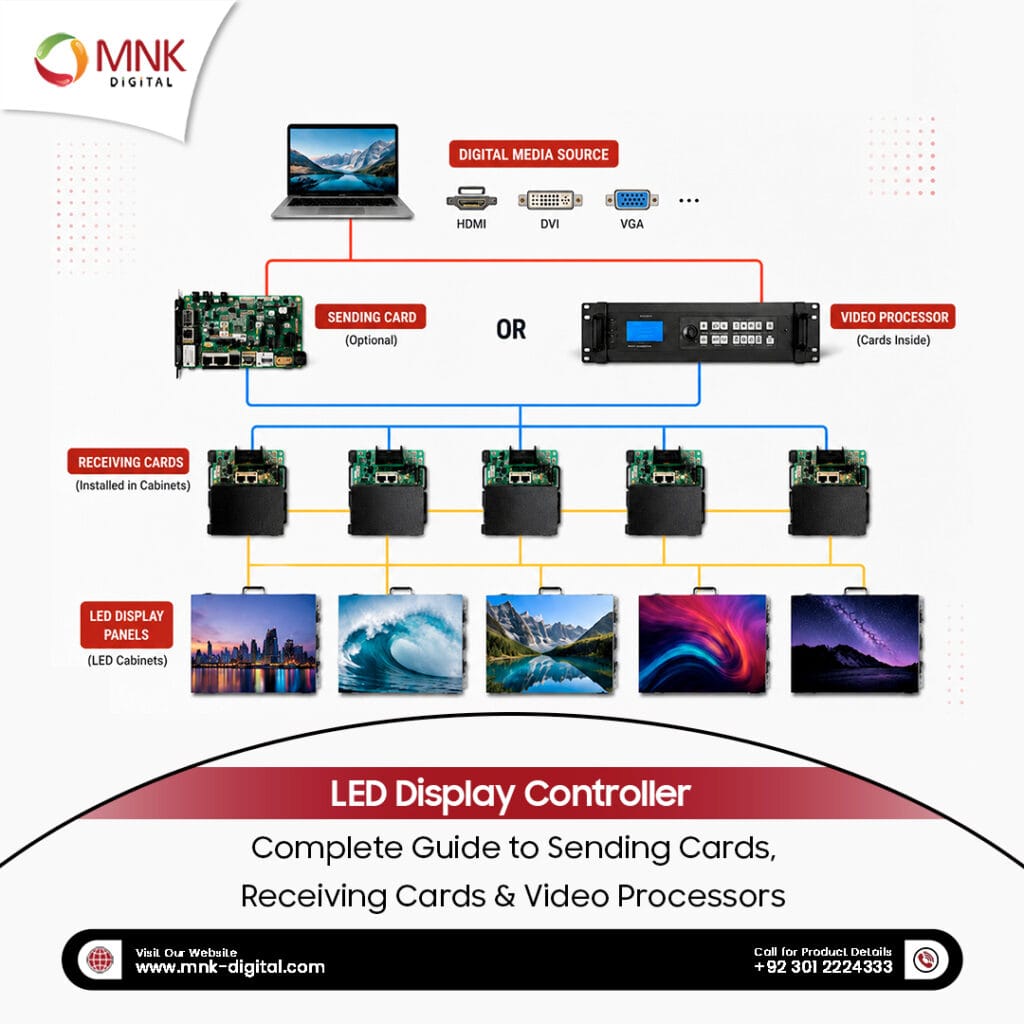
Content Source → Video Processor/Controller → Sending Card → Receiving Card → LED Modules
For example, imagine a company has a large LED video wall in its reception area. The content may originate from a computer. The video signal enters the controller or processor, where it can be scaled or adjusted to match the LED wall. The processed signal is then transmitted through the sending system to receiving cards installed inside the LED cabinets.
The receiving cards distribute the required data to the LED modules, allowing the complete screen to display the intended image. This communication needs to be properly configured. If the screen resolution, cabinet mapping, receiving-card configuration, or controller capacity is incorrect, the display may show incomplete images, incorrect layouts, flickering, or no image at all.
What Is an LED Sending Card?
A sending card sends processed image data from the control side to the receiving cards installed in the LED display. It essentially prepares and distributes the video information so that the LED screen can reproduce the image across its cabinets.
Sending cards are commonly selected according to factors such as:
- Total screen pixel resolution
- Number of Ethernet outputs
- Maximum pixel-loading capacity
- Supported input signals
- Refresh-rate requirements
- Transmission requirements
- Screen configuration
Some sending cards are installed inside a computer, while other systems use standalone sending boxes. The important point is that the sending system must have sufficient capacity for the LED display. For example, if your LED screen has a high total pixel count, selecting a controller with insufficient loading capacity can create limitations even if the LED modules themselves are capable of displaying high-quality content.
What Is an LED Receiving Card?
The receiving card is installed on the LED display side, normally inside the cabinet. Its job is different from the sending card. The sending card transmits the display data, while the receiving card receives that information and distributes it to the LED modules and driver circuitry.
Receiving cards are involved in functions such as:
- Pixel data distribution
- Cabinet mapping
- Refresh-rate configuration
- Grayscale control
- Module scanning configuration
- Display synchronization
- Communication between the controller and LED modules
A large LED wall may contain many receiving cards, depending on its cabinet design and configuration. This is why the receiving card must be compatible with the LED module, driver IC, scan mode, resolution, and overall control system.
Sending Card vs Receiving Card
One of the most common questions from LED display buyers is the difference between these two components. The simplest explanation is:
Sending card = sends the display data.
Receiving card = receives the data and drives the LED modules.
Think of the sending card as the source-side distributor and the receiving card as the cabinet-side receiver. They work together. Having a powerful sending card does not automatically solve a problem caused by an unsuitable receiving card. The complete control system needs to be designed as one system rather than selecting individual components without checking compatibility.
What Is an LED Video Processor?
An LED Video Processor is used when a project requires more advanced control over video sources and image processing. A basic controller may be enough for a simple LED advertising display. But a professional video wall may receive content from several sources, such as:
- Desktop computers
- Laptops
- Cameras
- Media servers
- Broadcast systems
- HDMI sources
- DisplayPort sources
- SDI sources
A video processor can help manage these sources and prepare the image for the LED display. Depending on the model, video processors may provide features such as:
- Input switching
- Image scaling
- Picture-in-picture
- Multiple source management
- Resolution conversion
- Image adjustment
- Screen splitting
- Multi-screen configurations
This makes video processors particularly useful for control rooms, conference rooms, broadcast environments, live events, corporate video walls, and large-format LED displays.
LED Controller vs Video Processor: What’s the Difference?
The terms “controller” and “video processor” are sometimes used interchangeably, but they don’t always perform exactly the same role. A sending controller primarily handles the transmission and distribution of data to the LED display. A video processor focuses more on managing and processing video signals before they reach the LED display. Modern products can combine both functions in one device.
For example, an all-in-one LED controller may accept several inputs, scale the content, process the image, and then send the resulting data directly to the LED receiving cards. This can simplify an installation because fewer separate devices are required.For a simple digital advertising screen, an advanced video processor may not be necessary. For a complex LED video wall with multiple live sources, it can be extremely useful.
Synchronous vs Asynchronous LED Controllers
Another important decision is whether your project requires synchronous or asynchronous control.
Synchronous LED Control
A synchronous system displays content in real time from an external source. For example:
Computer → Controller → LED Screen
If you move a video on the computer, the LED screen displays that change immediately.
Synchronous systems are commonly used for:
- Live events
- Corporate presentations
- Conference rooms
- Sports venues
- Broadcast environments
- Control rooms
- Stage LED screens
Asynchronous LED Control
An asynchronous system can store content within the controller or media player and play it without requiring a continuously connected computer. This can be useful for advertising and digital signage where content needs to run according to a schedule.
Typical applications include:
- Retail advertising
- Outdoor billboards
- Shopping malls
- Restaurants
- Corporate signage
- Public information displays
The right choice depends on how your LED screen will be used.
How to Choose the Right LED Display Controller
There is no single controller that is ideal for every LED screen. Before selecting one, start with the actual requirements of your project.
1. Calculate the Total Pixel Load
The total number of pixels on the LED screen is one of the most important factors. A larger screen with a fine pixel pitch can have millions of pixels. The controller must be capable of handling the required pixel load. Don’t select a controller simply because it supports “large LED screens.” Check its actual maximum resolution and pixel capacity.
2. Check Input Requirements
Think about where your content will come from. If you only need one computer connection, your requirements may be relatively simple. If you need HDMI, DisplayPort, SDI, multiple computers, cameras, or other sources, a video processor with suitable inputs may be more appropriate.
3. Consider Refresh Rate
Refresh rate becomes especially important when the LED screen will be recorded by cameras. A higher refresh rate can help reduce visible flickering and scanning issues in camera footage. This is particularly important for:
- Television
- Live broadcasting
- Sports events
- Stage productions
- Virtual production
- Professional photography
The controller, receiving card, driver IC and LED module should all be capable of supporting the desired configuration.
4. Look at Output Capacity
The number of available outputs affects how many LED cabinets and pixels can be controlled. For a larger screen, the system may need more outputs or additional signal-distribution equipment. Your installer should calculate the cabinet layout and distribute the load appropriately rather than simply connecting everything to the first available port.
5. Check Compatibility
Compatibility is critical. The controller and receiving cards must work with the LED module, cabinet design, driver IC, scan mode and required configuration. This is one reason professional LED display projects should be specified as a complete system instead of purchasing the controller separately without considering the screen hardware.
Why Configuration Matters
Even high-quality hardware can perform poorly if the configuration is incorrect. The control software is used to configure parameters such as cabinet arrangement, receiving cards, screen dimensions, mapping, and other display settings. A configuration file should also be backed up after successful commissioning. This is useful when replacing a receiving card or troubleshooting a screen later. Proper configuration and backup procedures can save considerable time during maintenance. For this reason, commissioning should be performed by someone who understands both the LED hardware and its control system.
Common LED Controller Problems
Many LED display problems are not necessarily caused by the LED modules themselves. Some common control-system issues include:
No Display
Possible causes include:
- Incorrect input selection
- Loose signal cables
- Controller configuration problems
- No output from the sending system
- Receiving-card communication problems
Part of the Screen Is Not Working
This can be related to:
- Receiving-card mapping
- Ethernet connections
- Cabinet configuration
- Output loading
- Power or module connections
Flickering Display
Possible causes can include incorrect refresh settings, signal problems, receiving-card configuration, driver IC settings, or other hardware issues.
Wrong Screen Layout
If cabinets appear in the wrong order, the problem may be related to screen mapping or configuration rather than the LED modules. A systematic troubleshooting process is therefore much more effective than immediately replacing hardware.
Which Controller Is Right for Your LED Screen?
The correct controller depends on your screen rather than simply the brand or price of the controller. For a small advertising display, you may need only a basic sending/controller solution. For a large commercial LED wall, you may need a combination of:
Video Processor + Sending System + Receiving Cards
For a live-event or broadcast application, additional requirements such as high refresh rate, multiple inputs, redundancy, and professional video processing may become important.
At MNK Digital, we help businesses select LED display control solutions according to the screen size, resolution, application, content sources and project requirements. Our controller solutions include options for different LED display configurations, including sending systems, receiving cards, multimedia controllers and video processors.
Final Thoughts
The controller is an essential part of an LED display system. The LED modules create the image, but the control system determines how that image reaches the screen and how accurately it is displayed. Understanding the difference between a sending card, receiving card and video processor makes it much easier to evaluate an LED display proposal and avoid selecting hardware that is either underpowered or unnecessarily complex. Before purchasing a controller, look beyond the model name. Consider your total pixel load, input sources, refresh-rate requirements, screen configuration, cabinet layout, compatibility and future expansion. For a professional LED display project, the best approach is to match the complete control system to the actual requirements of the screen.
If you are planning an LED display project in Pakistan and need help selecting the right controller, processor or receiving-card configuration, MNK Digital can help you determine the appropriate solution for your application.