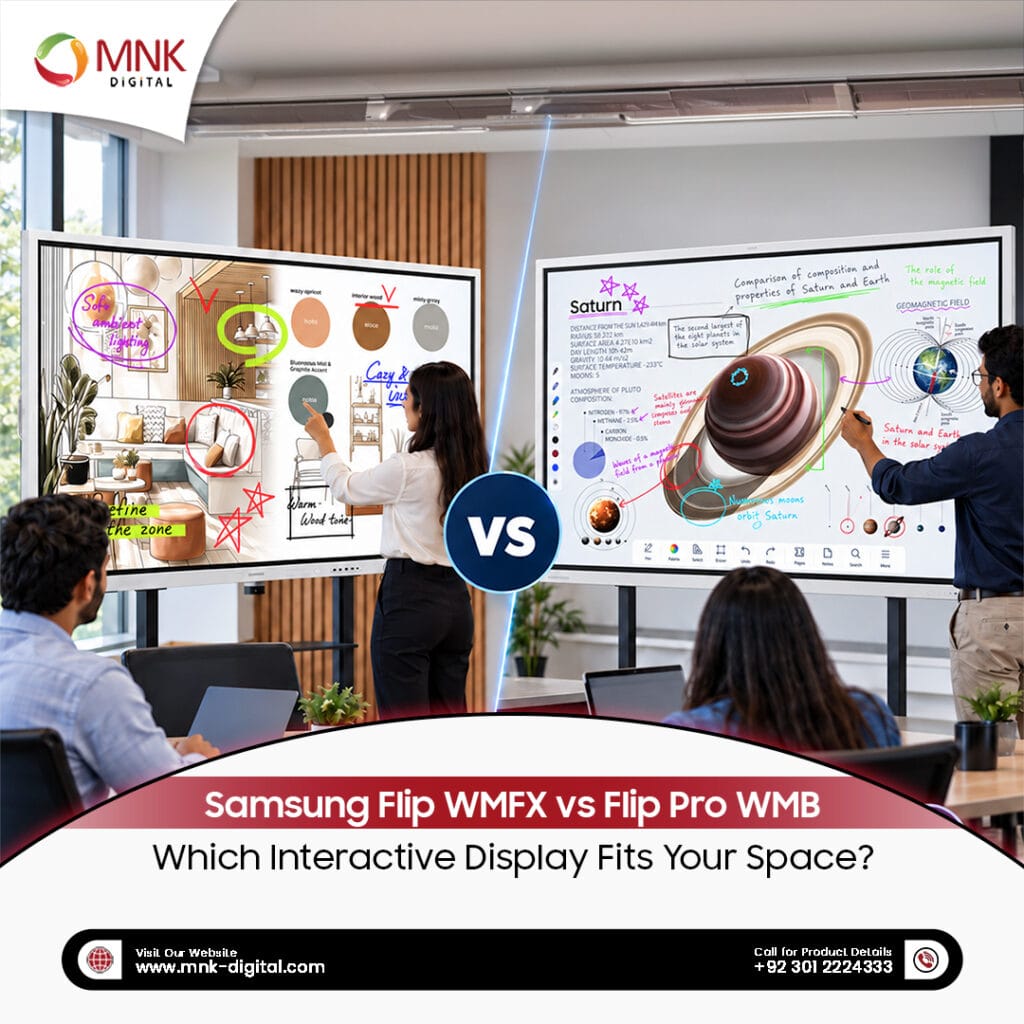
For years, classrooms and universities relied on traditional whiteboards to explain lessons and share ideas. As technology advanced, interactive displays brought writing, presentations and digital content together on one screen. Samsung Flip WMFX and Flip Pro WMB both build on that idea, but they offer different features. Here’s how to decide which one fits your space.
The real test comes when a teacher needs to start a lesson quickly, or a meeting guest walks in with a laptop and asks, “How do I put my screen up?” Samsung’s Flip Pro WMB and newer Flip WMFX are built for those situations. Both combine a large 4K screen with touch, writing tools and ways to share content. The choice between them comes down to how your team uses the display, the room it will occupy and the price of the complete setup.
If you are comparing these models in Pakistan, this guide will help you identify the differences that matter before you request a quotation.
First, check which model you are comparing
Flip Pro WMB refers to the WM55B, WM65B, WM75B and WM85B models. Flip WMFX refers to the newer FX models in the same broad size range. In both names, the number indicates the approximate screen size in inches. That makes a same-size comparison the most useful one. A 65-inch WMFX and a 65-inch WMB are easier to judge side by side than displays with different screen sizes. Ask the supplier for the full model code, because connections, accessories and installation options can differ across sizes and markets.
The comparison below uses Samsung’s published product information. Features should still be confirmed against the exact unit offered in Pakistan.
The Differences at a Glance
| What to compare | Flip WMFX | Flip Pro WMB |
|---|---|---|
| Display resolution | 4K UHD | 4K UHD |
| Published typical brightness | 450 nits, without glass | 350 nits, without glass |
| Operating system on checked models | Tizen 9.0 | Tizen 6.5 |
| Main emphasis | A newer home screen, collaboration tools and device security | Responsive writing, familiar Flip tools and flexible connections |
| Best reason to consider it | You want the newer platform and the room would benefit from a brighter display | It meets your workflow and the complete package is priced well |
Brightness figures measured “without glass” are useful for comparing specifications, but they do not tell you exactly how either screen will look in your room. Lighting, reflections, screen position and viewing distance also matter.
What changes when people start writing?
Both displays are designed for more than tapping through a presentation. Users can write, draw and annotate directly on the screen. That is useful when a teacher works through a problem step by step, or when a project team marks up a plan during a meeting. Flip Pro WMB has a strong, clearly documented writing experience. Samsung specifies 26 ms drawing latency under its single-touch test condition and support for up to 20 simultaneous touch users. Its pen and brush modes, quick tools and simple erasing make it easy to move from a presentation into an informal discussion. The latency figure is a laboratory specification, though; it should not be read as a promise that every action in every app takes 26 ms.
WMFX also supports collaborative touch and puts Whiteboard and Note On among the tools available from its Flip Home screen. The newer interface may be more useful if different people regularly take turns running the display. Instead of judging either screen by a feature list, ask for a short demonstration: open a document, write over it, change pages, erase something and save the result. Those five actions reveal far more about daily use than a polished product video.
Will the Room Benefit from a Brighter Screen?
On Samsung’s published specifications, WMFX has the clearer advantage here: 450 nits of typical brightness without glass, compared with 350 nits for the checked WMB models. That difference deserves attention in a bright classroom, a meeting room with large windows or a space where ceiling lights reflect off the screen. WMFX also has an anti-glare treatment described in Samsung’s product information. Together, these features make it a sensible model to examine for rooms where visibility has been a problem.
Do not choose on the brightness number alone. Place sample content on the display from the seats people actually use. Check small text at the back of the room and look for reflections from the usual lighting positions. A 55-inch screen that looks sharp from two metres away may simply be too small for the last row, regardless of its brightness. Screen size and placement can have a greater effect on readability than a specification difference.
How Easy is it to Share a Laptop Screen?
Both product families offer wired and wireless ways to bring content onto the display. Flip Pro WMB supports connections such as HDMI, USB and DisplayPort, with USB-C arrangements and other options that depend on the model and accessories. Samsung also describes wireless screen sharing and AirPlay 2 support on Flip Pro.
For WMFX, Samsung highlights an integrated USB-C hub and places Screen Share on the Flip Home screen. That could make a difference in a room used by visitors, rotating presenters or several departments. A presenter should be able to arrive, connect and begin without asking someone to find an adapter or change obscure settings.
Before buying, test with the devices your organisation actually owns. Bring a Windows laptop, a Mac if staff use one, and the phones or tablets commonly used in the room. Confirm whether a single USB-C cable carries the functions you expect, whether touch control works back to the laptop, and which wireless methods are available on the quoted model. A port labelled USB-C does not, by itself, answer all of those questions.
Software and Security: Which Matters to Your Organisation?
WMFX runs the newer Tizen 9.0 platform on the models checked for this comparison. Samsung’s Flip Home brings commonly used tools, including Whiteboard, Note On, Workspace and Screen Share, into one starting area. Samsung also describes Knox security for WMFX. Those details may matter most to an organisation buying displays for several rooms. If staff move between classrooms or meeting spaces, a consistent starting screen reduces the time spent figuring out what to press. IT teams should review security and management requirements with the supplier, especially where people may display confidential files or leave notes on a shared device.
Flip Pro WMB remains capable for everyday teaching and meetings. Its Tizen 6.5 platform supports the Flip experience and its established writing and sharing features. An older operating system version does not mean a display will fail at a straightforward task. The practical question is whether the software supplied with the particular unit supports the tools your staff need today.
Ask for a live demonstration of any feature that is essential to your purchase. That includes opening office files, joining your preferred meeting workflow, sharing from staff devices and exporting notes. Avoid assuming that an app name on a specification sheet guarantees the same experience as the app on a laptop.
Think About the Full Installation, Not Only the Panel
The quoted panel price is only part of the decision. A display may also need a wall mount or mobile stand, an optional connection tray, cables, installation and staff orientation. Larger rooms may need audio or video meeting equipment. This is particularly relevant when comparing Samsung Flip WMFX and Flip Pro WMB prices in Pakistan. A lower quote may cover fewer accessories or a different installation scope. Request an itemised proposal showing the full model code, included items, optional items, warranty terms and who will provide local support. If a particular accessory or connection is essential, have it written into the quotation.
The same approach helps with future costs. Ask how the display receives software updates and who your team contacts if a port, pen or touch function stops working. Those details rarely stand out in a showroom, but they affect the experience over years of use.
Which one should you choose?
Choose Flip WMFX if the newer interface, higher published brightness and security features address needs you can identify in your rooms. It is especially worth a close look where several people share one display, where staff need quick access to common tools, or where lighting makes screen visibility difficult.
Choose Flip Pro WMB if its writing, sharing and connection features already cover your daily work and the total installed price is more suitable. It can still be a strong fit for a classroom or meeting room where the team wants a clear, responsive interactive display without paying for features it will rarely use.
For either series, size may be the most important decision. Measure the room, consider the farthest viewer and decide whether the display will be wall-mounted or moved between spaces. Then compare models of the same size with the same accessories included. The best final step is a demonstration built around one real task. Ask a teacher to run a short lesson or a meeting host to connect their usual laptop, mark up a document and share the result.
If you are comparing Samsung Flip WMFX and Flip Pro WMB in Pakistan, MNK Digital can help you review the available models, accessories and installation requirements so you can choose a setup that works for your room.